
Strange Alliances
The many strange and often contradictory alliances formed both for and against Israel over the years.

There have been a number of strange alliances over the years opposed to Israel, many of those indeed shifting from its inception until today. But probably best to start with the UN, since it was lobbying of the UN and their final voting that led to Israel's formation.
The voting was strongly in favour of partition and Israel's creation, 33 votes vs 13 with 10 abstentions, so not even a close vote. Yet in strong contrast, over the past twenty years Israel has seen more resolutions against it than any other nation; indeed, as many against as all other Middle Eastern nations combined. To give some idea of the imbalance and ludicrousness of this, at the height of the Syrian Civil War, with Assad's forces shown to have used chemical weapons, there were only two resolutions against Syria versus six against Israel.
So how did this sea change happen, with the UN, having initially championed Israel's cause, becoming one of its main antagonists, often heavily complicit with those vying for Israel's downfall.
The first main sea change came in December, 1949, with the formation of UNWRA - set up to take care of Palestinian refugees - though it did not become fully operational until May, 1950. It is unclear at the outset whether this was meant to be a 'permanent' support for Palestinian refugees, since at the outset there might have been the hope or intention that their plight would only be temporary. Certainly, with Arab nations massing again against Israel in 1967, there was probably the aim among those nations that it would end at that point, Israel would be vanquished and the Palestinians returned. Though, of course, this backfired, in a matter of only six days.
There was yet another attempt by Arab nations to destroy Israel six years later in 1973 with the Yom Kippur war before they finally threw in the towel and started making peace deals with Israel. From this point on, 'permanency' became very much on the cards - which then set UNRWA apart from any other UN agency for refugees. The general yardstick is that refugee status is only temporary, after which it's fully expected that those refugees become accepted and integrated into other nations.
To highlight how ludicrous 'permanent refugee status' is, can you imagine the UK fully expecting the many Ugandan Asians absorbed in 1972 to return to Uganda, meanwhile keeping them in refugee camps. Or the many Cambodians or Koreans who fled to the USA or parts of Europe to return to Cambodia or Korea - meanwhile similarly keeping them in refugee camps. Yet this is what many surrounding Arab nations have done with the Palestinians who fled the war in 1948, and the world meanwhile has stayed quiet and in acceptance of this, with UNRWA playing an active part in its continuation.
Israel, of course, has rightly not stayed quiet on this, accusing various surrounding Arab nations of keeping Palestinians in refugee camps for their own political devices. One of the first heads of UNRWA, Lt. General Sir Alexander Galloway, was particularly blunt on the issue in an op-ed in the Daily Telegraph as early as 1952: 'It is perfectly clear that the Arab nations do not want to solve the Arab refugee problem. They want to keep it as an open sore, as an affront against the United Nations and as a weapon against Israel. Arab leaders don’t give a damn whether the refugees live or die.'
The number of Palestinian refugees has also greatly increased. 700,000 Palestinians were estimated to have fled the area in 1948, but now there are almost 5.5 million. This is an average increase of 7.86, whereas the average demographic increase of the area - such as in neighbouring Egypt - is 5.7.
This then could raise the thorny question, 'What constitutes a Palestinian?' There was in fact quite an influx of Arabs from neighbouring nations such as Egypt, Syria and Jordan between 1920 and 1947, paradoxically because of Jewish immigration. The large influx of Jews in that period, who had already started forming the future Israel and building cities such as Tel-Aviv, had also created something of an economic boom. They brought with them too advanced farming methods and also paid twice the going rate of Arab neighbours for labour. The numbers that flooded in during this period are played down by Arab partners, as much as they are probably played up by Israelis - but it appears in the end as if no contingent was made for this influx. If you were in the area for only a month or a year, that was it, you were suddenly a 'Palestinian'.
And, of course, with a sudden aid package for housing, basic income and food extending ad infinitum - which you wouldn't have if you were an Egyptian or Syrian Arab - many were keen to adopt 'Palestinian' status. While Arab nations have been happy to go along with this, in part because most of the funding for UNRWA comes from Western nations, it has caused some resentment among workers in other Arab or Muslim nations. Basic workers in Egypt, Syria and Pakistan complain that they get no such subsistence allowance for housing and food, that they are forced to work as servants and menial labourers in oil-rich nations such as Saudi and the UAE. So while there is sympathy for the Palestinians, there is also resentment in some quarters. It isn't all 'one-way support' in the Arab-Muslim world, even though this might be the official line touted.
But if various Arab nations are keen to support the Palestinians, why won't they allow them to integrate and absorb them into their own nations? Of course, the obvious is to keep them as a growing mass of 'possible returnees' which would then imbalance Israeli voting on a possible future 'one-state solution' - which many Palestinians now voice as their main hope - and would make Israel-Palestine yet another Muslim majority nation in the region. Lebanon, having been a majority Christian nation for six decades, became a majority Muslim nation ten years ago.
Indeed, that delicate balance in the Lebanon has been the main reason for them not accepting and absorbing Palestinians as part of their nation, meanwhile keeping them just in refugee camps - though that could have been bypassed by making them 'permanent residents' with all rights, as Israel did after 1967 with many remaining Arabs. Or as per my earlier 'peace plan’. But that isn't a factor in Egypt, Syria or Jordan, so what are their excuses? Jordan has in fact led the way with integrating a number of Palestinians into their society - though a large number still remain in refugee camps - this despite Arafat and the PLO in 1972 attempting to overthrow the then Jordanian King. Arafat claimed that 20,000 Palestinians were killed in what became known as 'Black September' and led to an offshoot terrorist group, later responsible for the Munich massacre of Israeli athletes.
Concern about absorbing possible Jihadist or terrorist groups might indeed be a factor - a number of Palestinians sided with rebel groups in Syria, and the Muslim Brotherhood in Egypt is closely allied with Hamas in Gaza. But all too often these nations merely voice their reluctance to absorb any Palestinian refugees 'Because it would then diminish their right of return to Israel-Palestine.' Could their riding on the coat-tails of an intended destruction of Israel through future mass Palestinian-Muslim immigration be any more open and obvious?
The other important shift within UNRWA has been in staff manning. Originally, many of the UNRWA staff would have been from foreign nations, who at least had a chance of being impartial. But now 99% of UNRWA staff are local Palestinians. Which of course would go some way to explaining why and how hundreds of miles of tunnels could have been constructed in Gaza under UN schools, hospitals and general UN facilities without UNRWA staff apparently knowing; why 3,000 UNRWA staff members openly cheered and praised the October 7th attack on social media; why a number of UNRWA staff were accused of taking part in October 7th and some hostages claimed to have been held in UNRWA staff homes; why UNRWA schools are full of text books demonizing Israel, spewing hatred towards Jews and praising 'martyrdom' - despite demands to withdraw these decades ago; why amongst the aid coming in, Hamas manages to siphon off supplies to build tunnels and stockpile guns and rockets without hardly any UNRWA staff members noticing; and yet with all this concrete and supplies coming in, not a single air-raid shelter or siren built - surely the first concern of any UN staffer, protecting the local populous; and why it's so difficult to get accurate stats out of Gaza which don't follow the Hamas line.
But surely much of this should have been obvious from the outset? Because trying to find a local Palestinian that wasn't pro-Palestinian and anti-Israel, as well as probably pro-Hamas or pro-Palestinian Authority, would be like trying to find an Indian who didn't like curry or a Jamaican who didn't like reggae. It goes with the territory. All of which is a backdrop to why President Trump has vowed in his second term to end USA aid to UNRWA.
In essence, while it's understandable that many Arab nations would be joined in opposition to Israel - a number of them having joined the Palestinians in three wars against Israel - it should be far less understandable, or indeed accepted, that a major organization such as the UN, which should remain impartial, would also be rallied against Israel.
But this opposition within the UN to Israel doesn't just stop there, and in fact is the other main sea change to have taken place over the years with the formation of the OIC - Organization of Islamic Cooperation. Formed in 1969, 56 of its members are in fact also members of the UN and tend to vote 'en-bloc' on issues. Which is why now there is such an imbalance of resolutions against Israel.
A die-hard hating Israel state such as Iran only needs to draft a resolution against, and a number of OIC members will support it (with the exception of Saudi and UAE, who have their own issues with Iran). Which then goes some way to explaining why Syria, at a time when they had openly used chemical weapons, only had two resolutions against that year to Israel's six. OIC members are reluctant to condemn fellow Islamic nations. Which has made something of a joke of UN voting and severely reduced its credibility over the past few decades.
Such has become the level of imbalance within the UN that a Geneva based organization, UN Watch, was formed by interested parties to observe and comment on the UN's more absurd actions and resolutions, with various politicians and journalists - among them a number of Israelis - indeed commenting live in the UN chamber. Noted past speakers have been Lebanese Christian, Brigitte Gabriel, and 'Son of Hamas' Mosab Hassan Yousef, speaking out against the rise in Jihadism and anti-Semitism.
Another main sea change which has ended up creating a strange alliance is that of the changing attitude of the Irish to Israel over the past forty years, in part because they see in the Palestinian struggle a reflection of their own struggle against British rule. But originally the Irish were very much in support of Israel. They were well aware, even well before the holocaust that, like them, Jews had suffered extreme prejudice, as evidenced by that previously cited oft-seen boarding house notice between the 1920's and 1960's, 'No Blacks, no Jews, no Irish.'
And initially, the Jewish struggle to form Israel was equally against the British, so on all fours with the Irish experience. Even when the British had left after the UN partition vote, Israel was still seen as a beleaguered state by the Irish - surrounded by several larger Arab nations vying for its destruction, it was still seen as very much the 'underdog'. A far cry from any colonial or imperial labels that could be attached.
The first smidgen of that change in attitudes came after the six day war, when Israel was perhaps perceived as not so weak and powerless. But still those surrounding larger Arab nations were allied against it, so it wasn't until the dust had settled on peace deals a decade later and the Palestinians were perceived as alone in their struggle that the first colonial and imperial labels emerged. Then with the advent of security divides after waves of suicide bombings, the 'apartheid' tag followed.
But what helped all of this on it way, not just with the Irish, but with the left-wing and any self-respecting 'freedom fighter' was Russia's grooming of Yasser Arafat in the meantime. Right after the 1967 Six Day Arab-Israeli war, Moscow got him appointed to chairman of the PLO, then in 1969, the KGB asked Arafat to declare war on American "imperial-Zionism" - a Moscow invention and a long favoured tool of Russian intelligence to foment ethnic hatred. The KGB always regarded anti-Semitism plus anti-imperialism as a rich source of anti-Americanism, with their 'grooming' of Arafat in fact going back many years.
Originally from a well-to-do Egyptian family, part of his grooming as a devoted Marxist by the KGB to become the future PLO leader was through them destroying the official records of Arafat's birth in Cairo, replacing them with fictitious documents saying that he had been born in Jerusalem and was therefore a Palestinian by birth.
Throughout this period, Arafat had forged close ties with the IRA, with al-Fatah as far back as the 1970s organizing arms and terrorist training for IRA operatives in Libya and Lebanon. This alliance and support ran deep, with in 2006 Sinn Fein's Aengus O'Snodaigh summing it up by describing Israel as 'without doubt one of the most abhorrent and despicable regimes on the planet.' And Gerry Adams later became one of the most vocal supporters of economic sanctions against Israel with BDS. So, the initial alignment between Ireland and the Palestinians has been between its terror groups and 'freedom fighters' rather than the Irish people.
But it has become heavily ingrained in Irish society today, with only a few years ago Irish author, Sally Rooney, holding up that same BDS mantle by announcing that, in solidarity with the Palestinian ‘cause’, she was rejecting her Israeli Publishers offer to publish her latest book in Hebrew.
Another area where Israel has found itself at odds is with Europe’s left wing – though this is more a loose, unspoken alliance – on the issue of Islamism and Jihadism. A few years ago an Israeli cartoonist penned a cartoon with a large swirling body of water marked ISLAMISM with a large dam marked ISRAEL, then far below a stretch of land marked EUROPE – as if Israel was the main thing holding back this tide of Islamism from flooding Europe. A somewhat simplistic and perhaps overstated view. But Israel is obviously baffled that when the number of Islamist and Muslim-separatist terrorist attacks in Europe since 1960 is a staggering 9,200-9,500 - a number of those in the 1960s and 1970s indeed ‘Palestinian cause’ linked – versus zero from Israel and Jews, Israel finds itself the main body pilloried and castigated by Europe’s left-wing.
With that cartoon, Israel obviously hoped that many in Europe would identify with it, having suffered similarly from terrorism (though to a lesser extent), but this didn’t happen. Almost a strange form of ‘Stockholm Syndrome’ whereby the victims sympathize with their attackers, or at least make excuses for them.
Though by far the most staggering 'strange alliance' has come from BLM (Black Lives Matter) support for Palestinians and Hamas. In the hours and days after October 7th, hundreds of BLM supporters on Twitter put up 'flying-kite with AK-47' symbols in support of Hamas's actions, without any consideration - or indeed knowledge - of the historical bond between Jews and the Black Civil Rights movement in the USA.
Having been victims of discrimination themselves, Jews were among the first to champion black rights. Jewish music companies were among the first to sign and promote black musicians and Jewish DJs were the first to breach the 'white only' playlists of many radio stations. Both Chess and Atlantic were Jewish record labels, and many of the early songs of Ben.E.King and the Drifters were written by Jewish songwriters. As was ‘Strange Fruit’, Billie Holiday’s iconic song about a 1930’s lynching.
The KKK didn't just target blacks, but Jews too. When three civil rights workers from New York, two Jewish and one African American - Michael Schwerner, James Chaney and Andrew Goodman - went to Mississippi to promote voting registration among African Americans, most of whom had been disenfranchised in the state since 1890, they were killed by the KKK for their activity. The incident caused a wave of national outrage which became the main kick-start for the civil rights protests of the mid-1960s and led shortly after to the 'Civil Rights Act' of 1964.
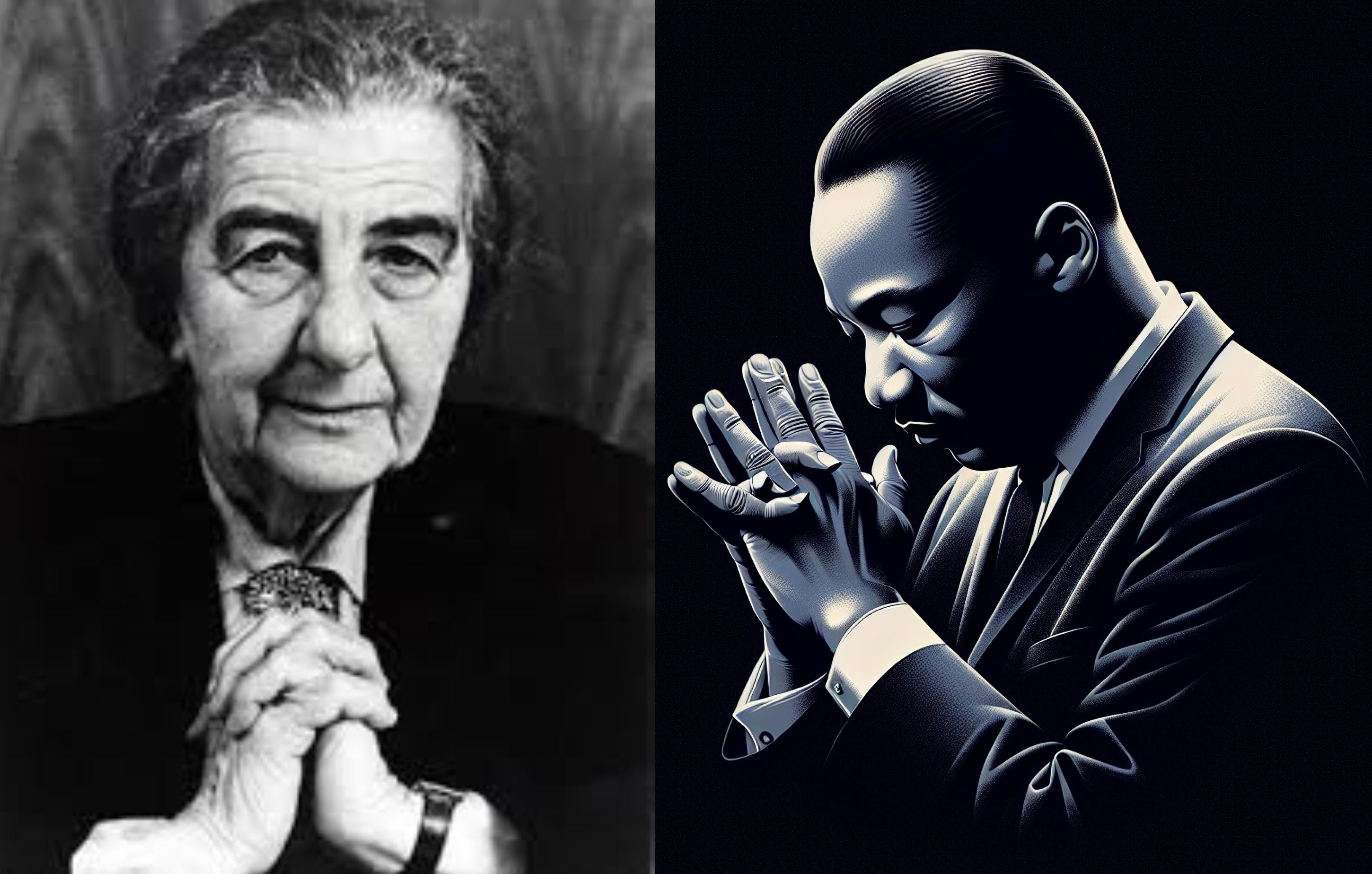
Martin Luther King was very conscious of this Jewish support, many of whom had marched alongside him in civil rights protests, and in turn was a big supporter of Jews and Israel, commenting that 'Israel’s right to exist as a state in security is incontestable.' And 'The whole world must see that Israel must exist, has the right to exist and is one of the great outposts of democracy in the world.' Then later, in response to a student attacking Zionism, MLK responded, 'When people criticize Zionists, they mean Jews. You're talking anti-Semitism.'
Theodore Herzl boldly proclaimed, ‘Once I have witnessed the redemption of my own people, I wish also to assist in the redemption of the Africans.’ Which was also echoed years later by Golda Meir: ‘We Jews share with the African peoples a memory of long years of suffering.’
MLK would be turning in his grave at seeing today's BLM reaction to Israel. Also forgotten in this mindless stampede by BLM to support the Palestinians, even in the light of extreme massacres, is Sirhan-Sirhan's assassination of Bobby Kennedy. One of the earliest Palestinian 'lone-wolf' attacks, at the time Senator Bobby Kennedy was campaigning to be the next US President. Central to his campaign was carrying the hopes and aspirations of millions of African Americans to champion their cause, with his death probably setting back the black civil rights movement by eight to ten years. But that mattered little to Palestinian Sirhan-Sirhan, who had never troubled to find out what Bobby Kennedy did for black people and the underprivileged in the USA. He'd made a pro-Israel speech, and that was enough to get him targeted.
The irony that BLM today was championing a cause that had set back their own civil rights cause nearly a decade - while at the same time denigrating those who had marched alongside MLK and helped their cause - is no doubt lost on most BLM supporters. Because, of course, it's far simpler to just latch onto a sound-bite or slogan than actually study a bit of history, even if it's your own history.
******
John Matthews - Notes from the Edge. If you like my articles and wish to receive them regularly - 2-3 a week on Israel, Middle East and World Affairs, plus now a comedy spoof and two thrillers in serial form - then I look forward to getting your subscription.
*** SPECIAL OFFER***
Until the end of March (extended from February), I will be offering a FREE book to all new subscribers: Past Imperfect, an intense groundbreaking crime thriller set between England, France and the USA, exploring the link between two young boys thirty years apart. This will be in Word for Windows form, which you can either read on your computer or transfer to your Kindle.
For all those who have already subscribed to me, I make the same offer of this free book if you add Notes from the Edge to your ‘Recommend’ list.
******
John Matthews is an experienced writer and journalist. The author of 24 books, including two centred around WW2 and the holocaust in the name of J.C. Maetis (his father’s original Jewish name) his first experience of writing about the Middle East came as a war correspondent covering the last years of the Lebanese Civil War, which led to his second book, ‘The Crescents of the Moon’. He has since written on the subject for a number of journals, including The Times, Sunday Times, Newsweek, The Independent and The Spectator. He was also in the run-up to the millennium editor of European Brief, the main magazine for the European Parliament, editing the likes of Tony Blair, Al Gore and Henry Kissinger on subjects ranging from the fall of the Berlin Wall and European unity, climate change and nuclear fusion to, once again, the Middle East. He lives in London with his wife and family.
******
John, an excellent article. In my discussions about Israel with friends and (Irish) family I have often raised the paradox that it was the UN who proposed the partition plan for separate coexisting Jewish & Arab states versus their current anti Israel position.
You are also spot on regarding the shifting position of Ireland, specifically post the six day war when a university led civil rights movement emerged in Belfast protesting about discrimination of Catholics. I graduated from QUB in 1968. When the Unionist government over reacted to these protest marches with extreme brutality the virtually defunct IRA saw an opportunity and re-emerged gaining a new grass roots support and which led to the so called Troubles.
As you rightly point out an association with the PLO emerged and the ideology of a common anti colonial imperialism was embraced.
Given that the vast majority of Ireland’s politicians and media class were born no earlier than the 60s it is not too difficult to see how their understanding of Israel became conflated with Ireland’s history of colonisation by Britain. I was 30 years old based in England when I first visited Israel on business a few years after the Yom Kippur War and saw first hand the position on the ground, and began my own study of Jewish history and the Palestinian conflict.
Am Yisrael Chai.
Thank you for this superb article, John! Indeed we’ve seen many strange alliances when it comes to the Israel-Palestine Conflict. You grapple with and explain them masterfully in this piece!
The United Nations is the body that created Israel in 1947 but since that time it has turned on the Jewish state passing thousands of resolutions against it while countries that have much, much worse human rights records and have actually committed human rights abuses like Russia, China, Iran, Syria, North Korea, Venezuela, Cuba, Myanmar, Congo, Saudi Arabia, Turkey, Belarus, Egypt, Sudan, etc. have had few or no resolutions passed against them. The UN in particular passed a resolution in 1975, UN Resolution 3379 to be exact, that declared Zionism a form of racism. This is of course a ridiculous charge and all the western nations voted against it and call it out. The United States’ Ambassador Daniel Patrick Moynihan gave a rousing speech in opposition to it. It would luckily be revoked in 1991 but it just goes to show the contempt the UN has for Israel.
The alliance between the Arab countries and the Palestinians is an interesting and complex one. When the Arab nations came to the aid of the Palestinian Arabs during the 1948 War this was merely because they had a common enemy, NOT because the Arabs cared about the Palestinians or wished to create a state for them. After the war was over, the Arab nations washed their hands of them and said they were the UN’s problem. They’ve kept them in poverty and as a second-class citizens. They have an actual apartheid system against them. They wanted and want to keep them in poverty and angry and bitter to use them as a weapon against Israel. Yet in public they claim to care so deeply about their cause.
Meanwhile, Arab countries give Palestinian refugees special perks that draw resentment from Arab workers. Though there certainly is sympathy for the Palestinian’s plight among the Arab street there is also resentment and prejudice towards Palestinians as well. The Palestinians get humanitarian support from UNRWA. UNRWA is a corrupt racket that in its schools teaches Palestinian children to hate Jews and Israel and become suicide bombers or terrorists. I did not know UNRWA was once run by foreigners but now is mostly run by Palestinians. This is a fascinating fact that explains why UNRWA does the opposite of what it is tasked to do. It is literally staffed by people who have an interest in keeping that hate alive and keeping that gravy train going in the case of Fatah and Hamas rather than being objective or neutral.
Ireland used to be very supportive of Israel and the Irish people identified with the plight of the Jewish people. But after the Six-Day War everything changed as Israel emerged as a regional power and came to be seen as now being Goliath rather than David. Also, the close ties forged between the PLO and the IRA would gradually pull the Emerald Isle into the Palestinian camp.
Lastly, the long-standing ties between blacks and Jews in this country fighting together for social and radical justice as well as Israel’s love and support for the peoples of black Africa is well-known. Theodor Herzl and David Ben-Gurion were both appalled by the injustices they saw done to black people in America. So it is all the more ironic and sad that BLM called Israel an apartheid state and stood with Hamas and had no problem with their atrocities on October 7th.